

Written by Ever Prel — I went to Gloucester for the day.
Last updated
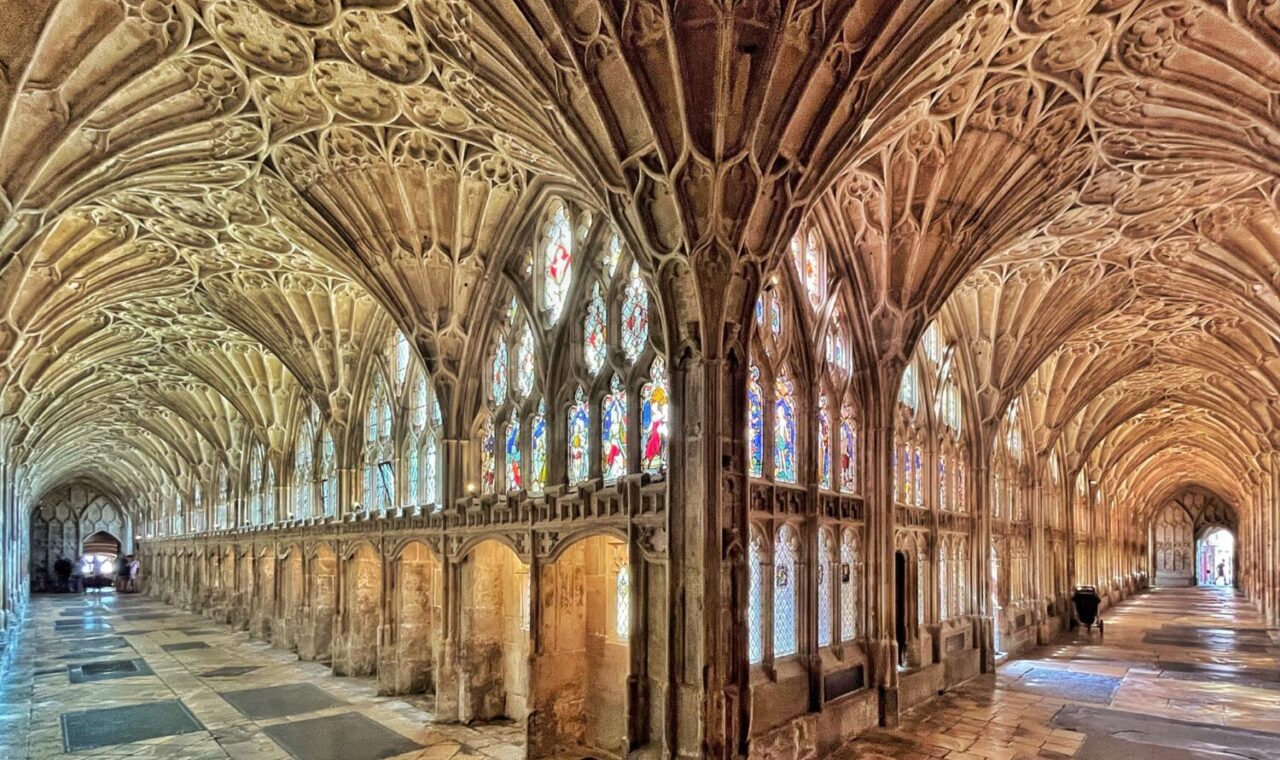
Gloucester Cathedral is the prettiest cathedral I’ve been inside, and almost nobody plans to go. Look up in the cloisters and you’re in the Hogwarts corridors from the Harry Potter films, standing under the oldest fan vaulting in England. And that’s only the start. Norman pillars as thick as tree trunks. A window the size of a tennis court. A murdered king’s tomb.
The best bit? Nearly all of it is free. Entry is by voluntary donation rather than a ticket, which for a building like this still strikes me as slightly unbelievable.
Table of Contents
Gloucester Cathedral at a Glance
- How long
- 1 to 2 hoursAdd a tour and it becomes half a day
- Cost
- FreeVoluntary donation, £5 suggested
- Open
- 10am to 5pmMonday to Friday. Saturday 10am to 4pm, Sunday noon to 2.30pm and 4pm to 5pm
- Need a car?
- No10 to 15 minutes on foot from the train and bus stations
- Tours
- From £6Crypt £6, tower £15, library £15 for adults
- Best for
- Harry Potter fansThe cloisters played the Hogwarts corridors
A Bit of History
The building you walk into began life as a Benedictine abbey, and the foundation stone went down in 1089 under a Norman abbot called Serlo. Christian worship on this patch of Gloucester runs four centuries further back than that.
Then came 1216. King John had just died mid-civil-war, the crown jewels had gone missing somewhere in the Wash, and his heir was nine years old — so they crowned the boy here rather than at Westminster, in a circlet borrowed from his mother.
It remains the only English coronation since 1066 to happen anywhere but Westminster Abbey. A century later came the windfall that made the place: Edward II was killed at Berkeley Castle in September 1327, and the wealthier abbeys nearer Bristol wanted nothing to do with the body of a deposed king.
Gloucester took him.
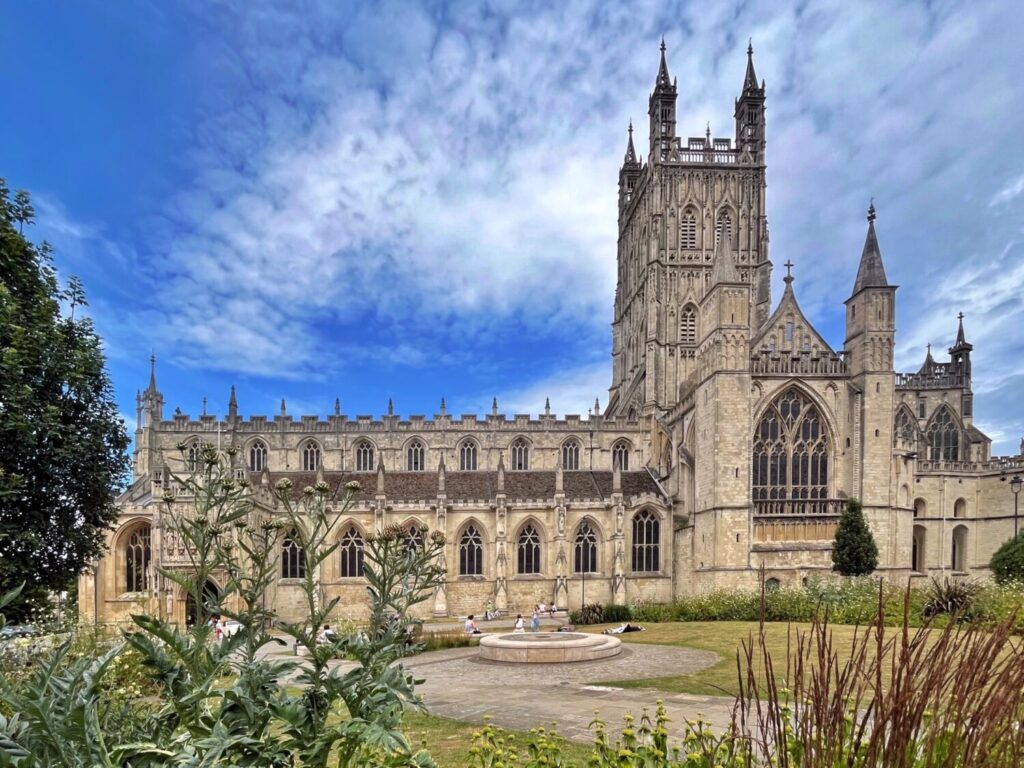
Pilgrims arrived in such numbers, and left such generous offerings at the tomb, that the monks used the money to rebuild the east end of their own church.
The abbey was dissolved under Henry VIII and refounded as a cathedral in 1541, dedicated to the Holy and Indivisible Trinity. Nobody has ever called it that.
Things to See
Ten of them, in roughly the order you’ll meet them if you come in through the south porch and work your way round.
The Architecture
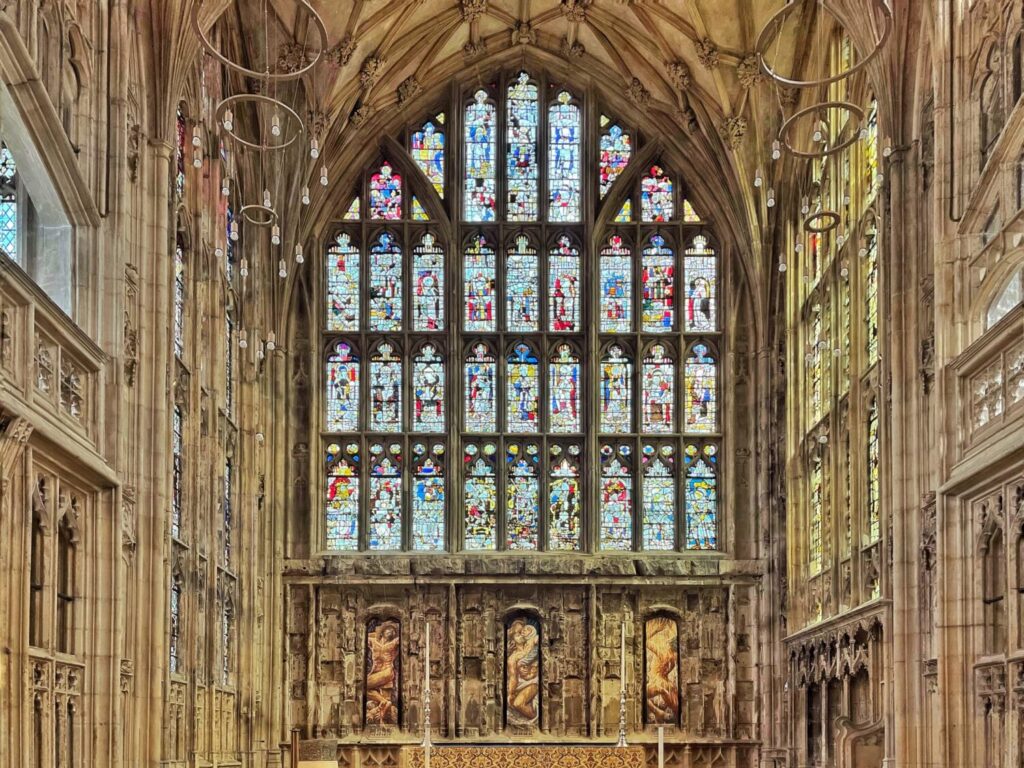
The Lady Chapel, at the far east end — almost more window than wall.
Here’s the thing about Gloucester that gets buried under all the wizard stuff. This building is where English Perpendicular Gothic was invented — the vertical panelled style with the enormous windows you know from King’s College Chapel. It started in the south transept, rebuilt in the 1330s, and dominated English building for two hundred years.
Invented here. Copied for two centuries.
Nobody ever knocked the Norman church down, though. They dressed it. Fourteenth-century masons hung new tracery over the old Romanesque core like a cage, so you get squat eleventh-century arches with delicate vertical stonework running down them. The same nerve runs right to the back of the building, where the Lady Chapel is very nearly more window than wall. The cathedral’s own architecture page walks through it phase by phase.
The Nave and Choir
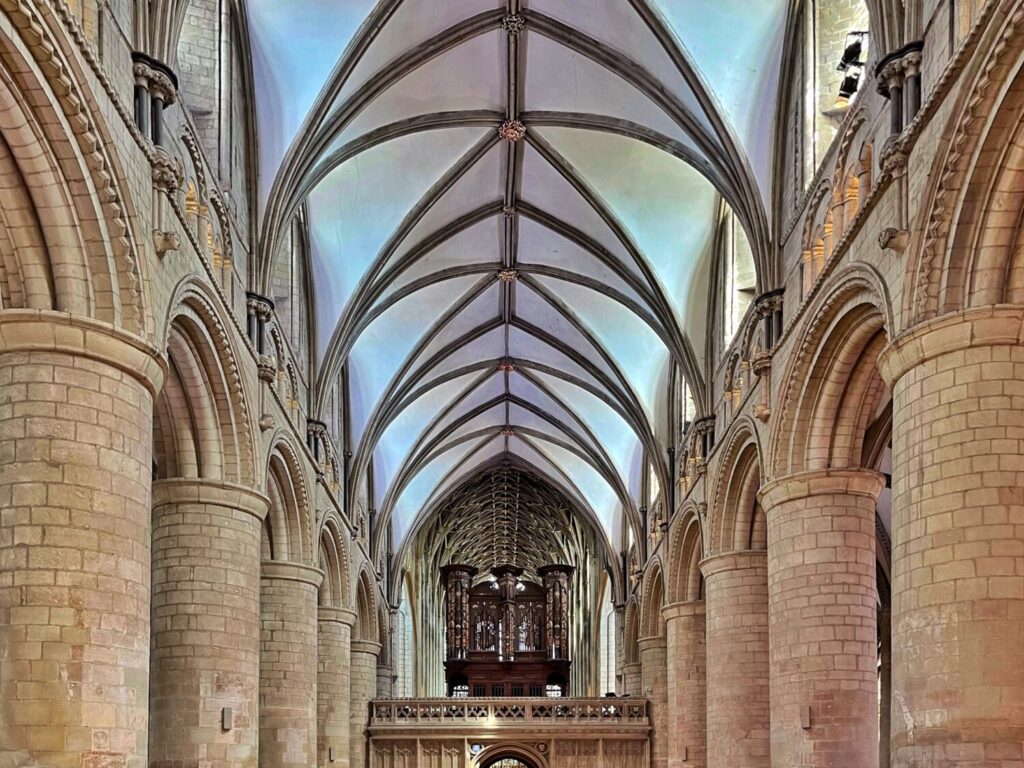
The pillars are Norman. The vault above them is 1242.
The nave is the oldest thing above ground and the least meddled with. Those pillars have been holding the roof up since around 1120 — a good thirty feet tall, close to six feet across, and set so tightly together that walking down the middle feels more like a corridor than a hall. Most cathedrals make you feel small. This one makes you feel held.
Look at the stone around head height and you’ll find scorch marks from the 1122 fire, still legible on the piers nine hundred years on. The vault above you is the 1242 replacement, which is why it looks a century smarter than the columns carrying it.
Walk east and the building changes character completely. The quire goes vertical and bright, with a vault overhead carrying four hundred carved bosses and an entire orchestra of angels playing instruments.
And ask a steward about the misericords under the quire seats — carved around 1350, and full of medieval nonsense: animals dressed as people, a man being tipped out of a wheelbarrow.
Edward II’s Tomb
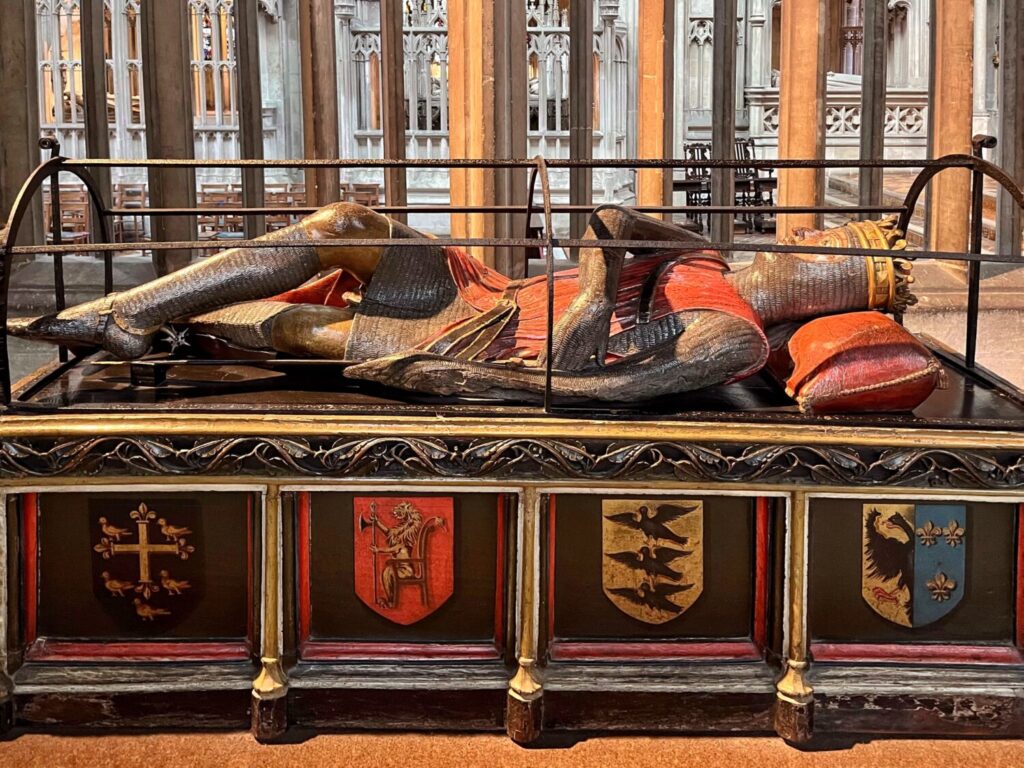
Robert Curthose, William the Conqueror’s eldest son — never a king.
You’ll find him on the north side of the ambulatory, behind the high altar, under a canopy of pale limestone that looks like somebody shrank a spire. The effigy is English alabaster, and the face is one of the loveliest in any English church: long, calm, faintly sad.
Edward III commissioned the tomb in the 1330s, by which point the offerings pilgrims left here were already paying the masons. It’s the only surviving royal tomb in the South West.
A few steps further is a second monument, easier to miss. Robert Curthose was William the Conqueror’s eldest son and Duke of Normandy — never a king, which is rather the point of him. His painted bog-oak effigy lies cross-legged in the presbytery. He lost England to two younger brothers and got a better monument than either of them.
The Great East Window
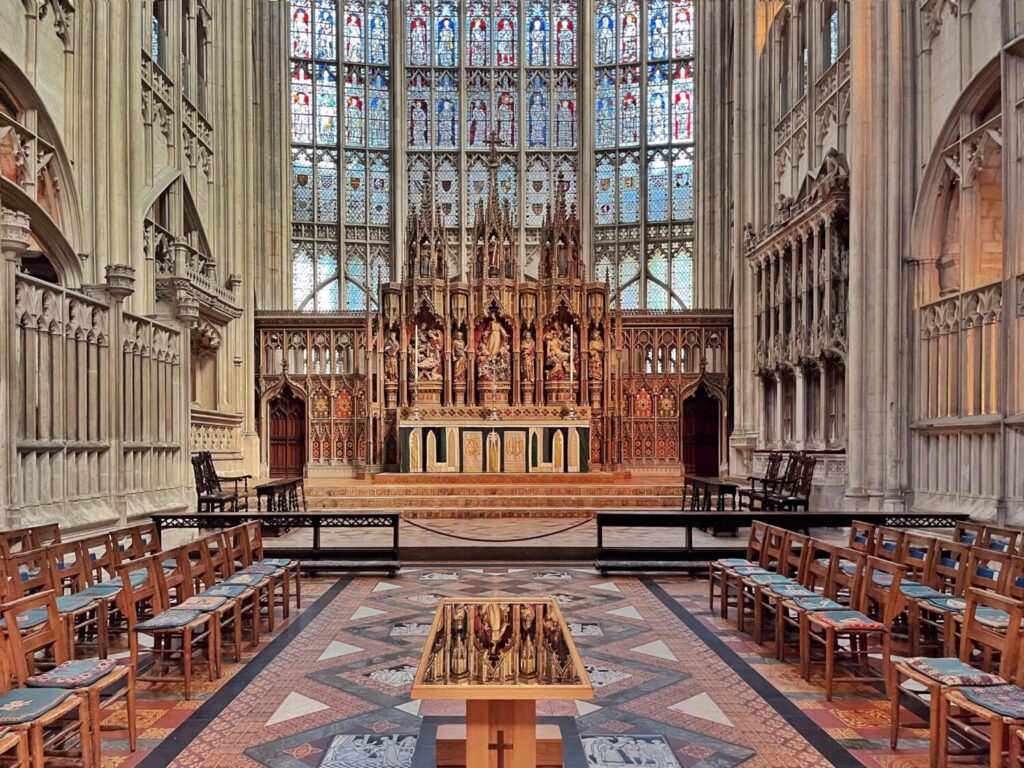
The numbers do most of the work here. Twenty-two metres tall and twelve across, the size of a tennis court as the cathedral likes to put it, and when it was glazed in the 1350s it was the largest window in the world.
The subject is Christ and the Virgin in majesty with the twelve apostles, but the part worth your attention is along the bottom. Those heraldic shields belong to the knights who fought at Crécy and Calais in 1346 and 1347. It’s a war memorial.
And you can get closer to it than the floor allows.
The Whispering Gallery
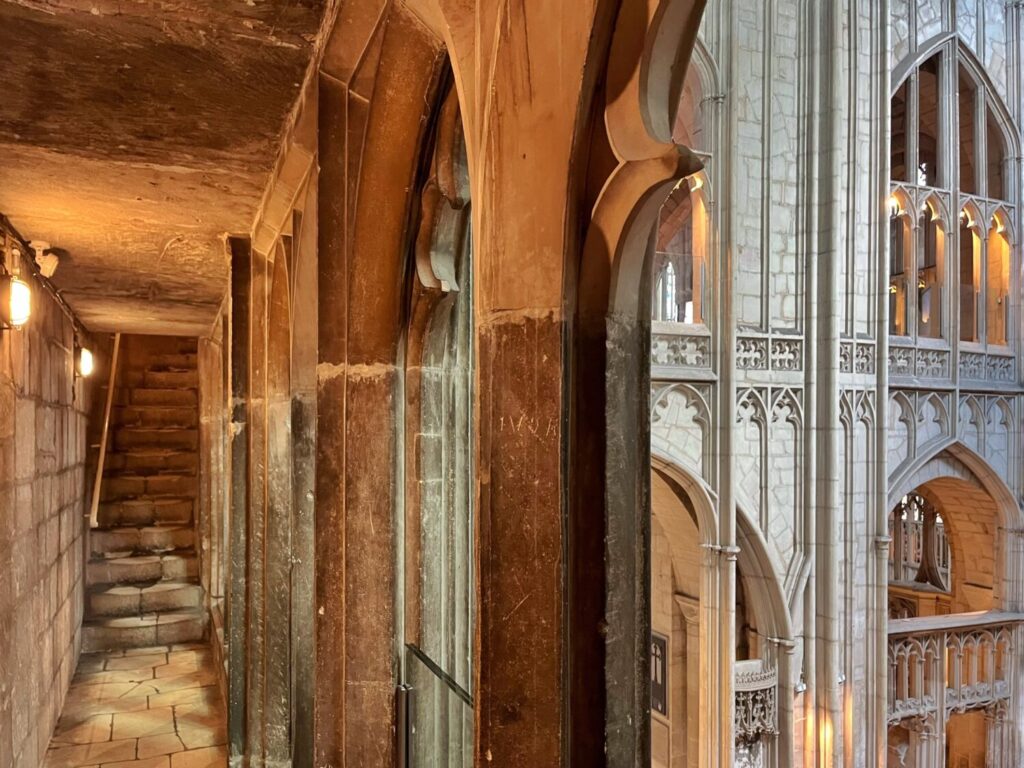
Most people never find it. A short flight of stairs off the main floor takes you into the Tribune Gallery, a walkway looping round the east end at high level, where you come out looking back down the full length of the church.
Halfway round is the Whispering Gallery: a narrow stone passage running the whole width of the building behind the glass. Not a dome like St Paul’s — a tunnel, and it holds a whisper so tightly that the thing arrives at the far end intact.
The Royal Society were down here testing it in 1662, and a plaque still puts it better than any acoustician since: Doubt not but God who sits on high, thy secret prayers can hear; when a dead wall thus cunningly conveys soft whispers to the ear.
The Cloisters
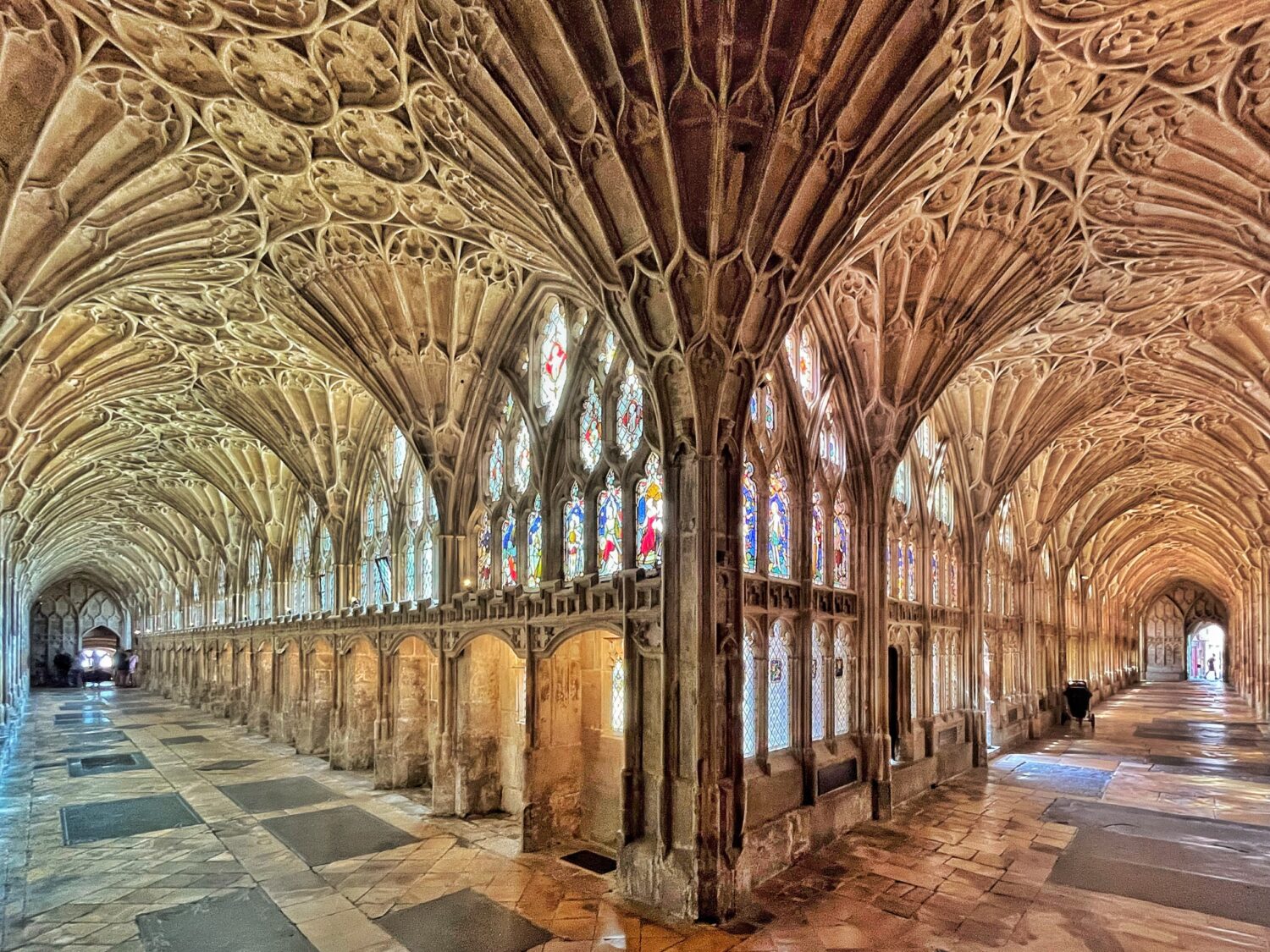
This is the one people come for, and it earns that even with the films stripped out of it. The fan vaulting overhead is the earliest surviving anywhere in England — the east walk went up in the 1350s, the rest by 1412 — and every fan vault built in this country afterwards, King’s College Chapel included, traces back to this one square of covered walkway.
Stand in a corner and look straight up. The ribs spring out of each column and open like something grown rather than something built.
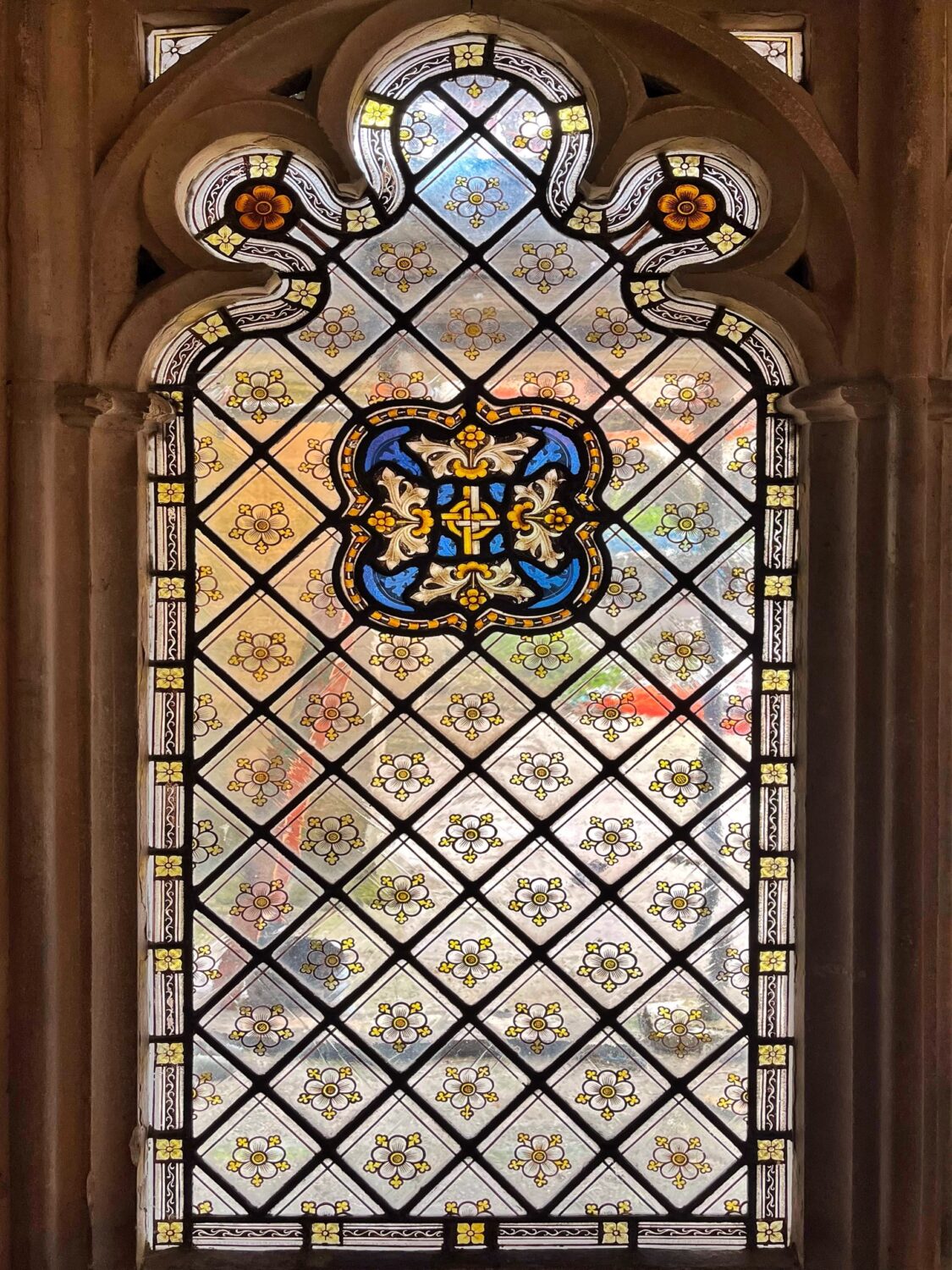
Two details are worth hunting. The north walk holds the lavatorium, where the monks washed their hands before meals — the stone trough is still there. The south walk has twenty carrels: arched study booths under the windows, one monk to a desk.
The Treasury
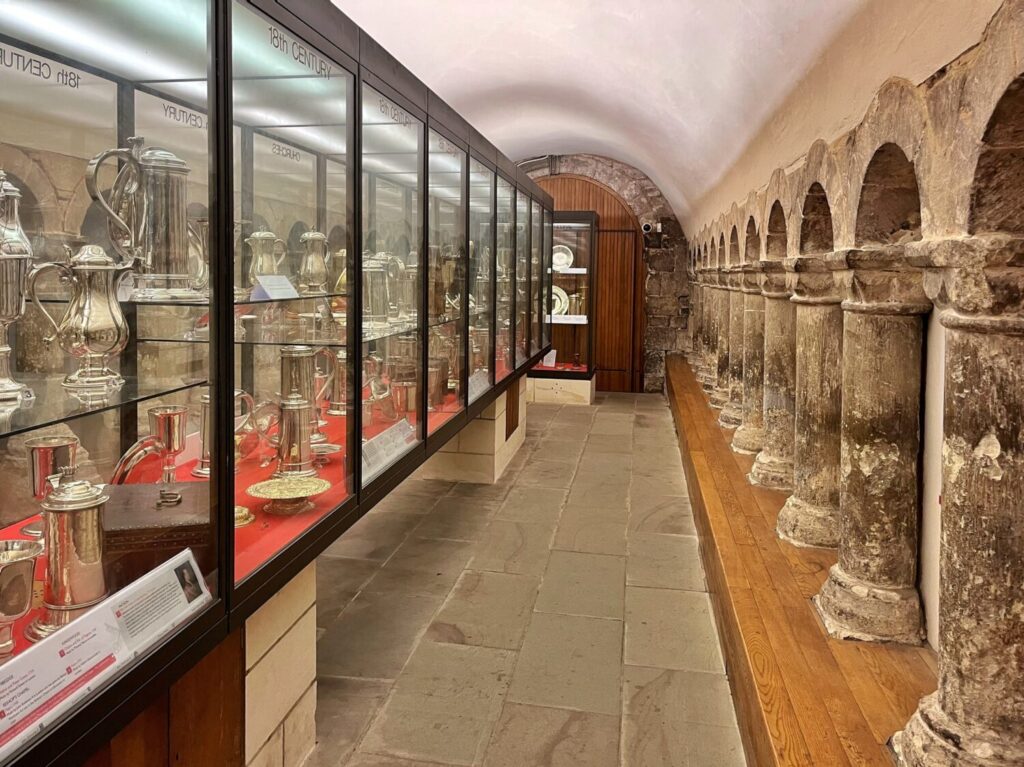
Nobody tells you about this room, and it’s easy to walk straight past. It’s over on the north side of the church, a few steps down from the main floor, and walking into it costs you nothing.
A cathedral treasury is where the silver ends up — the chalices, patens and alms dishes that parish churches hand over rather than leave in an unlocked village vestry. Gloucester’s runs down a low vaulted passage, cases along one side and a row of stubby Norman columns down the other. After an hour of craning your neck at ceilings, a room you look down into comes as a relief.
The Library
Directly above the Treasury, and reached only on a tour. The room was built somewhere between 1400 and 1450 to hold the abbey’s manuscripts, which makes what happened next fairly bleak: almost all of them were scattered and lost at the Dissolution, barely a century after somebody built them a home.
What’s shelved up there now is a later collection, more than six thousand books and manuscripts gathered since, in a long room most visitors never learn exists.
Two rooms stacked on top of each other, and the cathedral advertises neither.
The Crypt
Underneath all of it sits the oldest part of the building, and the part most people walk straight over. The crypt went in around 1089, before anything above it existed: a low apsidal chamber with three chapels radiating off the far end.
What makes it worth booking is the evidence of panic. Within about thirty years the monks worked out the piers weren’t going to hold, and you can still see where they thickened them. It’s the only place in the cathedral where the builders look fallible.
It’s also where Mary is taken captive in the film Mary Queen of Scots.
The Tower View
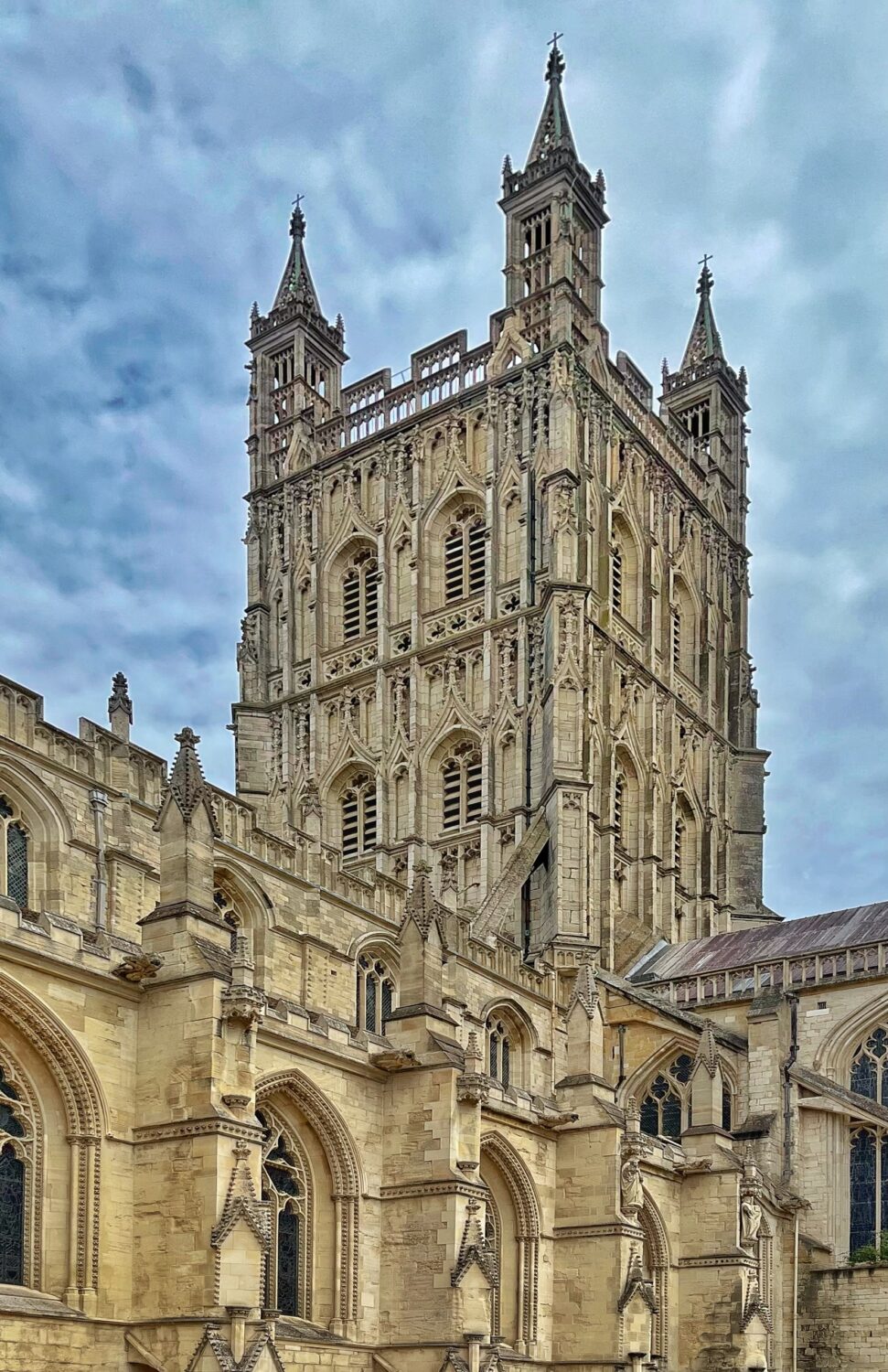
You have to book this one. The tower went up in the 1450s, begun by Abbot Seabroke and finished after his death by a monk called Robert Tully, and at 225 feet it’s the thing you see from every road into Gloucester.
It’s 269 steps and about an hour with a guide, up a proper medieval spiral. You stop at the ringing and bell chambers on the way, where Great Peter hangs — a bourdon bell just under three tons, and the largest medieval bell surviving in Britain. It hasn’t been swung since 1878.
At the top there’s a roof deck, and the view runs out across the docks and the Severn to the Malvern Hills. Tours run to a set timetable through the season, so check the guided tours page before you build a day around getting up there.
Harry Potter at Gloucester Cathedral
If you’ve seen the films, you already know this space — you may just never have known where it was. Gloucester was one of several buildings stitched together to make Hogwarts, and every Harry Potter scene shot here happened in the cloisters: Philosopher’s Stone, Chamber of Secrets and Half-Blood Prince.
So here’s what to look for. Fan guides place three Philosopher’s Stone moments in the cloisters: the walk McGonagall leads the new first years on, the wooden door that stands in for the way into Gryffindor, and the monks’ washing trough, where Harry and Ron hide from the troll.
Chamber of Secrets came back for two more — the wall where the Chamber of Secrets has been opened appears written in blood, and the corridor left ankle-deep by Moaning Myrtle’s bathroom.
Nothing has been dressed up for it. No signage, no floor markers, no gift shop wizardry — it’s a working medieval cloister that happens to be extremely famous, and you find the shots by standing in them.
Harry Potter isn’t the half of it, either. Sherlock filmed here in 2015, Doctor Who came for a Christmas special, and Wolf Hall and Mary Queen of Scots both used the building — Visit Gloucester keeps the full list.
Opening Times, Parking and Getting There
The cathedral opens Monday to Friday from 10am to 5pm and on Saturdays from 10am to 4pm. On Sundays it opens from noon to 2.30pm, then again from 4pm to 5pm. Hours shift for events and special services, so the What’s On calendar on the cathedral’s website is worth a look before you set off.
The address is 12 College Green, Gloucester, GL1 2LX, a 10 to 15 minute walk from both the train and bus stations. If you’re driving, parking in the Cathedral Close is for pass holders only, apart from eight Blue Badge spaces, so head for one of the public car parks within walking distance, or use Gloucester’s Park and Ride.
Cycling in? Route 41 of the National Cycle Network runs through the grounds, with bike racks on Cathedral Green. And if you’re spending the day in the city, my article Is Gloucester Worth Visiting? 10 Reasons to Visit guides you through the rest of it.
Is It Worth Visiting?
Yes, and the reason is the ratio. Nine centuries of architecture, the earliest fan vaulting in England, a murdered king under an alabaster canopy, the window that was once the largest on earth — and it costs you whatever you put in the box on the way in.
That donation matters more than it looks.
It costs £7,600 a day to keep the place open and the cathedral receives no regular government funding, which is a sentence worth reading twice while you’re standing underneath the east window.
Give it an hour if you’re passing through, two if you’re going to do the cloisters properly and take the stairs up to the gallery, and half a day if you’re adding one of the tours.
The cathedral posts current opening times on its own visitor page, which is also where closures for services and events turn up.
You’ve done the best building in the city. Now here’s everything else worth an afternoon of your time.
Read my full Gloucester guideFrequently Asked Questions
Been to Gloucester Cathedral yourself? I’d love to hear your favourite bit in the comments below!


Leave a Comment